The views on this site are completely our own and do not represent VSO. Use the links below to navigate.

22 Nov 2011

Cambodian Rural Development Tours


Since I started my VSO placement in February I've been planning to write a bit more about what I actually do.  I'm not being lazy, just waiting for something concrete to share besides the bits and pieces I've mentioned in passing.

I love a project and the one I'm currently involved with is very exciting, so here's a bit of context followed by what we've done about it.

Making Markets Work for the Poor
My VSO placement is funded by the global consultancy firm Accenture as part of their 'Making Markets Work for the Poor' programme.  This supports development in a different way to the common approach of sending money to build schools, buy medicines, provide food handouts etc.  It aims to analyse how market systems work in developing countries with a particular focus on the role(s) played by the poorest people within them.  This information can then be used to develop practical ways of improving the position of the poorest through these very same market mechanisms.  (If you're interested in more reading on the overall approach then this is a good starting point.)

CRDT and Tourism on the Mekong
The NGO that I am based in (CRDT) have developed community-based eco-tourism sites on two islands in the Mekong (Koh Pdao and Koh Preah).  The objective is to generate incomes for those on the islands through developing tourism that respects both the communities and the local environment.  This is only possible if visitor numbers can be increased to make tourism a viable form of livelihood for sufficient numbers of people on the islands.  Given their relatively remote locations it is difficult for tourists to get there independently and so CRDT has historically facilitated this process in the form of an informal tour booking service.  However, the office location and low levels of marketing have presented a barrier, or blockage, in the market (tourists) reaching the destination(s).

While CRDT was grappling with this problem, the wider context presented a very interesting opportunity.  Tourists visiting Kratie did not have access to even basic tour information or booking services.  This is not just for the islands managed by CRDT's communities but also the many other attractions in and around the town and province.  As a result, tourists were largely required to fend for themselves.

In another part of the country (Phnom Penh) there were also plans afoot to embark on a marketing drive to support the recently developed Mekong Discovery Trail.  This initiative promotes tours and activities in the provinces of Kratie and Stung Treng.  The obvious lack of tour booking services in Kratie was also problematic for the people involved in marketing the Mekong Discovery Trail.  This was a blockage in another form, closely aligned with the problem faced by CRDT in promoting the Mekong islands.

Cambodian Rural Development Tours
If you've been following this closely you might have guessed what happened next.  CRDT approached the Mekong Discovery Trail to propose that CRDT provide a tour booking service in Kratie Town.  This would serve the wider interests of developing tourism in Kratie, while also addressing the real needs of CRDT in increasing visitor numbers to Koh Pdao and Koh Preah.  In turn, this would boost incomes on the islands and help to improve the livelihoods of those who live there.

In terms of the market system, this move would provide a vital link where one was previously missing.  This link is the provision of a service for tourists to make it easy and safe to get to the places that they might otherwise have missed or not even heard about.

Planning and Implementation
The planning of this initiative kicked off back in May and has involved an incredible amount of hard work and effort from the team at CRDT and its partners.  I have been supporting all of this and, in the last month, our efforts reached a crescendo.  This culminated in last night's official launch of Cambodian Rural Development Tours (CRDTours) at an event held at its new office on the riverfront within the premises of the recently opened guesthouse Le Bungalow.

This more prominent location, marketing efforts integrated with those of the Mekong Discovery Trail and the forthcoming high season for tourists will give this new venture the best chance of success it could hope for.  Further, in addition to meeting its objective of getting more tourists to the islands on the Mekong, CRDTours will also generate valuable income for the development work of CRDT.

I'm very happy to have been able to support the development of this initiative but in reality the hard work starts now as we strive to make it work as planned.  Here is a little photo essay of the journey so far and do visit the CRDTours website to see what we're doing and to plan your next trip to Kratie and Stung Treng.

Bon voyage!

Back in June a handful of the team at CRDT plotted possible attractions on maps of Kratie and Stung Treng.  CRDTours benefits hugely from this local knowledge and there are still a number of places that I am still yet to visit.

We also took time to discuss and plot the various needs of tourists and the stages that they go through in planning where they visit, how they get there and what they do.  We considered the different sources of information at these different stages to help support our future marketing efforts.  Here's Tola adding one of his contributions.

It would never be possible to offer everything at once so the team used a system to evaluate and prioritise opportunities.  These were assessed according to the ease with which we could implement them and the scope they offer for making money for CRDT.  Here Samnang puts a choice on the sheet while Mao contemplates his next move.

It is always important to consider who the other relevant organisations and individuals are, as these provide a key component of the context in which we will be operating.  Our mapping exercise attempted to provide a simple listing, but also some categorisation of the broad types of organisations: customers; partners; competitors; regulators etc.

We then used these categories to plot the relative levels of influence that these people and organisations have against their own likely interest levels in our project.  As you can see, this provoked a strong debate which benefited from the ease of movement offered by the post-it technology employed.

The result of these and other meetings and activities was a draft plan of action which was presented to the Mekong Discovery Trail and CRDT's Board of Directors for approval.  With this step complete it was down to the nuts and bolts of project implementation, of which the most highly visible component was the design and construction of the new office.  This experience provided one of my favourite pieces of insight into how things get done in Cambodia.  The 'design' of the office was presented to the builder in the following format.


Construction was then almost stalled because the builder and his team of labourers were occupied with the crucial rice harvest which has started in the last month or so.  We upped the cash to be paid and this allowed us to have the completion date we wanted.  However, no further technical drawings of the building were prepared before construction started in earnest. 

On my return from Ratanakiri I was very happy to see the mainframe already erected with concrete feet on the pillars to stop our office being blown away or stolen.

Next on was the thatched roof made from a local type of grass dried and layered to offer protection from the rain.  (This is yet to be tested as we're fortunately in the dry season right now.)

Finally was the bamboo 'walls', the raw materials delivered each day from the countryside by Kratie's traditional horse and cart.

Finally, on Sunday, 20th November 2011 we were able to move in with many members of the team pulling together on the weekend to kit out the new office.  Here we are in (almost) ascending height order.

This is Tola who will be based in the office most of the time checking out his new territory.

This is Mao, Executive director of CRDT, sizing up our signboards for the front of the office and display on the street.  Currently a small legal snag is delaying the display of these but a letter received today should help to ease that soon.

Here we see Tola with a customer who got a deal before we had even formally opened and, on the right, Nick Ray, author of Cambodia's Lonely Planet guidebook.  The next edition will be out in Autumn next year, featuring CRDTours.

Here's Rory, our in-house designer and now architect, blowing up a balloon and Ken from VSO in Phnom Penh checking his messages as we prepare for the official opening of CRDTours.

Tola is all smiles in the booth which is now a more colourful home as a result of our decorating efforts.

 Here's me chatting with Ken and local guide Haki ahead of the drinks and nibbles arriving for the launch.

 Mao addresses the audience, a mixture of CRDT staff, local business people, VSO volunteers, journalists and community members who had travelled into Kratie for the event.

 Hands in the air for CRDTours launch photo taken from the balcony of Le Bungalow guesthouse.

 Here we all are again, gathered in front of the booth happily celebrating CRDTours' official opening ceremony.

 Back to reality with a bump as more decorating efforts make the office bright and colourful for Tola's firsy day at work.

 This is the view that tourists will see when they walk along the riverfront past the CRDTours office.

Tola at his desk waiting for his first customer.  News of them and hopefully much more to follow as the project evolves.  Thank you to everyone in the team who has worked so hard to make this happen, I am sure it will be a huge success and contribute to the development context discussed earlier.

20 Nov 2011

Heroes in a Half Shell

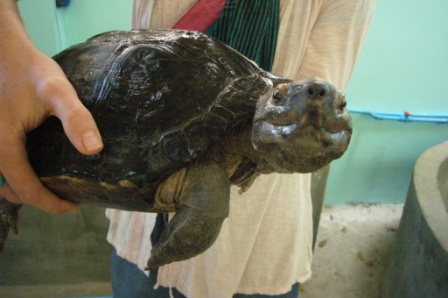
 Cantor's soft shell turtle at about two years old

When Gilly's parents were here we took the opportunity to visit the recently opened Mekong Tutle Conservation Centre, about an hour and a half by motorbike from our house.  It was a great experience, not least because we got to get to grips with many of the turtles they're working to protect.

 Gilly's Mum with a little one.

Gilly feels the weight of this big one 

He looks on sceptically as he's passed to me. 

Who is this chump? 

Happy days. 


There was lots of information about the various turtles that live in the Mekong and other parts of Cambodia. It seems a bit rude to call an innocent turtle a big head but that's what's happened!

He is cute!

For those who got the 1980s cartoon reference in the title of this post, here is the song in full (link here with lyrics):


13 Nov 2011

What's in a Name? (Rattanakiri Part Two)


I think Ratanakiri might be my second favourite place in Cambodia so far, second only to Kratie of course.  Despite the long bumpy journey I've now been there three times and loved each visit more than the last.  This time we were with Gilly's parents and we hired a local Tampoun guide to take us around.

Because I had already made friends with some of the community when I visited in September I asked our guide if he could take us to visit them.  First up was a basket maker (see picture above, more about him here).  He was pleased to see us and very happy that I'd bought a print of a photo I'd had taken with him back in September.

The meeting house in the basket maker's village. 

We then travelled a short way to another village which is home to a number of weavers, it's quite amazing to watch them at work and I still can't figure out how they keep the designs in their heads.


One of the weavers is the wife of my namesake Sam who we had arranged to visit on our tour.  She pulled out this piece of kit (above) to show us how she makes her pieces from scratch by first spinning the cotton picked from the tree.  The video shows her doing this, although it wasn't working as usual because the cotton should really be dried first before spinning.


 Some finished pieces on display.


After a while learning about the spinning and weaving, Sam came home and unexpectedly invited us all in to his home for lunch.  He also gave us a demonstration of this musical instrument which was hanging on the wall.

In addition to buying a number of woven pieces from Sam's wife, we were also presented with some as gifts from the family.  When you consider that each pieces takes 5-7 days to make, their generosity becomes apparent.

However, perhaps most interesting was a conversation along the following lines (Sam's full name is Yung Sam):

Yung Sam: How old are you?
Sam Roberts: 33
Yung Sam: We share a name so we are one family.  You are much younger than me so that means that you will become my son and I will become your father.
Sam Roberts: That's very kind of you.
Yung Sam: Tonight we will have a ceremony to become one family and to inform the spirits.
Sam Roberts: OK, see you then.

The appointed time for the adoption ceremony was six o'clock that evening...

We then left for the lake (see part one), only to return later.  We spent a lot of time discussing the forthcoming adoption and the possibility of it being quite serious became apparent when our guide informed us that my 'father' had organised free entry into the lake for us all...

All smiles after lunch. 

 Sam & Sam.

We were joined in the evening by two other VSO volunteers, Janet and David, while Gilly's parents took some rest back at the hotel.  We weren't quite sure what to expect, but first up was some food.

Gilly, David and Janet at dinner. 


The generator had been turned on for this special occasion and that also meant that the TV was on.  All the children from around the village were soon camped out on the other side of the room, completely absorbed by the film and largely disinterested in the ceremony happening with the foreigners across from them.

The first part of the ceremony involved us stirring the freshly prepared jar wine with reeds and making our wishes for the future out loud as we did so.  Following this a number of short white threads were dipped in the wine.  We then took turns to tie two threads around each other's wrist as a symbol of our families joining together.

(Yung) Sam's daughter tying her thread around my wrist.

 (NB. It was dark and the mobile phone has a torch to light the tying.  Most of the light in the pictures is from the camera flash.)

Janet also receives a thread from Yung Sam's wife. 

Gilly receives. 

Gilly gives. 

 Finally I tied my threads around Yung Sam's wrist.

As with all Tampoun ceremonies we drank jar wine.  We took turns to pull the liquid from the jar into our mouths through a bamboo reed and rubber tube attachment.

An early hit. 

Janet's turn. 

David, you're up! 

Gilly glugs, although not really as she was faking it because she had to drive me home... 

One by one everyone dropped out of the circle leaving just me and our guide/interpreter.  I felt like I couldn't drop out so I was the last to sip from the jar.  It was struggling to find space in my stomach by the end and let's just say that the next morning this space was quickly found again, probably something to do with the quality of water used to make the wine...


The real significance of the event became very clear when Yung Sam and his wife insisted that I called them mother and father.  An unforeseen consequence of our families becoming one is that both Gilly and I now have five more sisters and three more brothers!  It also looks like we'll be getting an invite to the wedding of the last unmarried daughter/sister next year.  Gilly's (actual) Dad pointed out that there is currently a problem with the efficiency of the adoption agencies in the UK, perhaps they could learn a thing or two from the Tampoun!

It was a very touching ceremony and we were taken back by the kindness and generosity of the family throughout the day.  It is strange to think that if I wasn't called Sam then this would never have happened.  In Tampoun culture, there's more to a name than you might think...