The views on this site are completely our own and do not represent VSO. Use the links below to navigate.

7 Feb 2011

TEDxReview


So I eventually made it to Phnom Penh and last weekend's TEDx event.  Here I'll attempt to provide a digest of a great day featuring equal doses of inspiration, reflection, entertainment and interaction under the umbrella theme of 'Building the Future'...

Here's me and my fellow TED-sters setting out in style.  From left to right: Laura; me; Kath; Ingran; Alex (happy birthday smile from him!)

The journey passed the first large-scale piece of painted advertising that I've seen in Phnom Penh.  Not quite a Ghostsign yet but a step up in size from these. Hello!

The venue for the event was Northbridge International School which, for just over $140,000 at current prices, allows you to send one child from Kindergarten to Grade 12 (that's the end of A-levels equivalent).  This includes access to the playground above and the swimming pool below.

Pretty luxurious, it's been a while since I've seen water as clear as this!

We were ushered into the main event room to the sound of Kung Nai, a master in the Chapei tradition.  He's apparently referred to by some as "the Ray Charles of Cambodia" and he was playing what sounded like a ballad on this chapei dang weng, a long-necked lute.  He was getting a few laughs but my Khmer listening skills meant I didn't get the jokes.  I hadn't though of making a video at this point so here's a Youtube clip of him in action.

 
I was so engrossed in watching him play that I almost completely missed the work of Keeda Oikawa in action.  She's a Japanese artist and was free-styling with a canvass and some paint to produce something inspired by the performance and the venue.

Here they are both on stage together.

And the finished artwork which remained on stage for the whole day.  A better photo here.

Next up were a couple of presentations, one about the concept of Self Education and another from former advertising executive, Mike Rios, on giving ourselves a 'Dong Chim' every now and then to avoid quarter- and mid-life crises.

He had something of a personal revelation when he realised his work in advertising was not helping people gain success and happiness, contrary to what the advertisements might suggest.

His mentor at the time advised him to "go be crazy" so he quit and now focuses on advertising with a social purpose.  His new motto is "make meaning, not money" and he reminded us of how everything we do can have a positive impact, whether that is directly or indirectly.

Next up was a brief introduction to Tiny Toones, an organisation working with young people to help them "dance their lives around".  There was then a performance choreographed by the dancers telling the story of how Tiny Toones has helped them overcome problems such as addiction, sex work and domestic violence.  Here are a couple of videos of them in action...


The story ends with the Tiny Toones dancers reaching out their hands to invite a new member into the safety, support and fun provided by the dancing.

After every few performances/presentations there was an opportunity to share ideas with those near to you.  Here are Kath and Ingran deep in conversation.

One of the sessions we got to discuss was a film from the producer (Rob Lemkin) of Enemies of the People followed by an interview with the director (Sambath Thet).  The film hasn't made it to Kratie yet but there is already a follow up in the making.  Sambath Thet discussed the need for films like this to be part of the process of Cambodia coming to terms with the horrific recent history in the country.

Throughout the day we also watched some videos from TED events around the world.  This one was especially inspiring.  (Many more videos are available on the main TED site and a small collection of my favourites here.)

We heard Kounila Keo's passionate arguments for the benefits of blogging for personal and social development.  She writes the popular Blue Lady Blog and is a trail-blazer for Cambodia's tech-savvy youth, while also advocating greater freedom of expression here and abroad.


(And LUNCH.  I put a bit too much chilli on my soup and ended up in tears and a runny nose.  The chilli-training continues despite this minor setback.)


The afternoon sessions opened with Chris Brown who talked about IT and software start-ups and gave some good advice on how to ensure that failure is cheap and also some neat ways of testing the market with only small initial investments.  Some useful thoughts that I will no doubt use in the future.

Channe Suy of InSTEDD shared her experiences with innovating in rural development and how text messaging is assisting with the early warning systems for contagious diseases such as Cholera.

A brief energiser required those who can't count to 20 in Khmer to get on stage and learn to do so in 60 seconds.  Luckily my language skills meant that I wasn't among those pictured on stage.

This was followed by talks from Colin Wright who moves country every four months based on votes from his blog readers (see Exile Lifestyle for more) and Chris Noble who runs the Footprints Network which helps travellers donate money to the communities they visit.

We also heard from Theary Seng, author of Daughter of the Killing Fields.  She gave a clear account of the current extraordinary court proceedings against the former Khmer Rouge leaders and how this needs to be complemented by other activities such as community-based truth and reconciliation work in order to truly have peace and justice in Cambodia.

The day ended with Phloeun Prim from the Cambodian Living Arts organisation who works to promote and preserve Cambodia's rich and diverse arts heritage.

It is estimated that 90% of Cambodia's artists were killed during the 1975-79 period.  Many of those that have survived are now teaching new students through Phloeun's organisation in order to keep the knowledge and skill alive.  These include visual artists, musicians, dancers and artisans and Kung Nai (see above) is among the 'Masters' passing on their skills.

It was an inspiring and optimistic talk including the observation that not many countries have a symbol of their architectural history on their national flag.  This serves as a constant reminder that Cambodia is a nation with a proud artistic history, "the arts are in the DNA of our culture", and that this should now be carried forward to help define the future of the country.

But it wasn't quite over.  Phloeun Prim introduced another master, this time of the Smot tradition, and her student to give a performance.  Here are a couple of video clips to give a brief taste of what they did.

The Master

The Student

The lyrics (of the last song)

Speakers and organisers gather for a team photo.

And for those more visually inclined, here is an illustration/mind-map from  Keeda Oikawa of all the speakers, their topics and the day in general.  She was 'doodling' away at this all day after her opening performance.


 My one slightly critical observation on the day was that the audience were clearly a mixture of educated Cambodians and ex-patriots (as evidenced with the large number of hands shown when asked who has a first degree).  I would also guess that most came from Phnom Penh.  I believe that the energy and optimism felt by the audience, and more widely in Phnom Penh, isn't matched by similar feeling in the countryside (as touched on in my essay submission).   This was perhaps one question that wasn't explicitly dealt with in any of the talks and I think it is impossible to talk of building Cambodia's future without reference to what that means for Cambodia's majority, the rural poor.

In summary it was a great day full of inspiration and optimism.  The organisation was excellent and the event ran in a very slick fashion.  I'll definitely go again if it's happening next year.

(The whole event was being filmed so I'll also update here as and when I hear of any of the talks being posted online.)

4 Feb 2011

TED Talks

I'm just waiting for the bus to Phnom Penh to get there ahead of tomorrow's TEDx event.  The good news for those who can't attend is that all the talks are being streamed via the website across the day.  So that's Saturday, 5th February from 9.15am to 5.00pm.
I'll hopefully get some photos and post a little write-up of the day when I get back.  (Still waiting for the bus...)

1 Feb 2011

Me and the Mekong

Two bits of good news following Gilly's sad news...

First, I have now formally been appointed as a VSO volunteer here in Kratie Town.  My official title is Management & Marketing Advisor and I will be performing this role on behalf of an organisation called the Cambodian Rural Development Team (CRDT).  They work with poor rural communities in Northeast Cambodia in order to increase their access to food, clean water, sanitation, energy and product and tourist markets.   All of this work is carried out in conservation areas in order to address the human and social aspects of conservation efforts.  I'm very excited about the role which will keep us here until February 2013.

Second, as part of my induction into CRDT, I was invited to attend a very special trip along one of the most important stretches of the Mekong River, the so-called 'Central Section'.  This runs through Stung Treng and Kratie provinces and is an area of globally critical biodiversity.  The trip was organised by CRDT, WWF and another local NGO called CED.  It was designed to bring some donors that fund projects into the very area that their money helps to conserve.  Here is a little photo essay to show you what this involved.

We set out early on Thursday morning on these 'big' boats from a small village just South of Stung Treng Town, North of where we're based in Kratie.

We stopped for breakfast and the driver of one of the other boats turned up with this mutilated fish carcass.  It had been attacked by a freshwater dolphin who decided it was too big to eat and left it gasping for life.  It was still breathing and a few of us joked that we should fry it up for lunch.  Little did we know that it was then rushed to the next village where it was indeed fried up and served to us for lunch.  It was actually quite tasty!

We stopped on a remote island in the river where the locals grow watermelons and go fishing to support themselves.  Here are some nets drying in the sun.

Areas like this where the river recedes in the dry season to leave small sand banks and rapids in between are prime spots for the lives of many animals and birds.  It was very peaceful and I wanted to go swimming.

Lots of the group were bird watchers (or 'birders' to use the technical term) and so the trip was doubling up as an opportunity to do some 'birding' which resulted in spotting some very rare species.

To see some of the rarest birds we had to decant into these smaller boats because the big ones would run aground in the shallower waters.

Here you can see a boat being constructed in the boat yard of one of the villages we stayed in over night.  David from the MAC Foundation gave one of the handmade tools a go, this ingenious hand drill.

Sorry for the odd angle but hopefully you can see how the tool works.

Here are Dim and Mao, two staff from CRDT, and the organisers of the logistics for the trip.  They did a great job.

Look how low to the water these boats are with just four people inside.  I drew the short straw and had to sit at the front which involved getting repeatedly soaked by the spray coming over the sides.

We stopped at a village inhabited by the indigenous Phnong people.  They told us about their imminent displacement from their land due to encroachment from a foreign rubber company.  They also treated us to a short performance of their local rhythmic music.

They're pretty tight, look at each person only hitting the gong infrequently to give the overall effect when combined with the others.

One of the benefits of the trip was having a lot of experts in the group who were able to tell us all about the environment we were travelling through and the associated conservation and social issues.  In this picture we see Mao, Executive Director of CRDT, Geoffrey from WWF's Bangkok office and Greater Mekong Program and Rob who is a biologist responsible for much of the research in the area we were going through.

This girl was leading these enormous water buffalo to drink in the river.  What she would have done if they'd kicked up a fuss I don't know...

A typical scene on the river.  During the wet season the leaning tree is covered by the heavy flowing water which leads to this distorted growth.

Lots of the journey was on fairly fast flowing rapids through scenery like this.  The boatmen intimately know every stretch and bend of the river and were able to guide us through safely.

Another stop to do some birding, this time right in the heart of the central section.  On the tripod is the heavy artillery, a telescope that was trained on a white chested eagle which even I was was pretty impressed with. 

Here I am, partially soaked from previous stretch of rapids but still smiling nonetheless.

Dim, Mao and me, the CRDT team in the heart of the central section.  Thumbs up!

Our team of trusty boatmen taking a well earned rest, smoking a fag and chewing the fat.

We've struck gold, or at least these people think they have.  We came across this relatively recent mining effort which is a worrying new development as it involves digging up huge sections of the river bank.  The challenge is providing enough incentive to stop the mining which is being done out of necessity rather than any malicious intent for the environment.

Mao makes some enquiries to learn more about the work that these people are doing and what they gain from it.  A lot of work for little gain is the response, but it's more than they can get from anything else so they persist.

You can't really see it from the photo but the result of the panning is this tray of tiny grains, some of which are gold and shining in the sun.

Fully extracted and ready to sell.  This vial will fetch around $3.

More water buffalo, this time in a small herd, some bathing, some just chilling out on the beach.

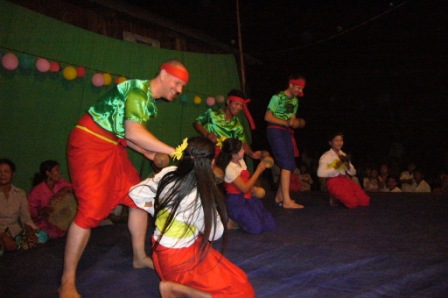
Our second full day ended with arriving on Koh P'Dao which is one of CRDT's project sites and home to an eco-tourism initiative.  We were treated to some traditional Phnong dancing performed by the local community arts group.  It was a great show including what I have called the coconut dance and the pipe dance.  Volunteers from the audience were then invited to join in and you know what happened next...

Nice pair of coconuts!  Half a shell in each hand and then striking them against my partner's in time with the music.  When I volunteered I didn't realise I was going to get kitted out with the full outfit.  The trousers/skirt were actually quite comfortable...

A very brief glimpse of me in action, my partner is smiling at least so that must be a good thing...

Take a bow, me and Jack from CEPF the performers alongside Samnang in white from CRDT.  Samnang runs CRDT's environmental education programme, much of it in collaboration with the community arts group (see the previous post on Koh Preh for more on the education work in action).

More of the group join for a final bow and photo.

And the last dance, this time out of costume...

The last day I woke up to this sunrise which was quite a treat.  All in all it was a fantastic trip and a great insight into the places that CRDT's work aims to conserve through building sustainable livelihoods for the people that live there.  Roll on the next two years.

27 Jan 2011

A little bit broken...

On Tuesday, I woke up at 5.30am and got ready for my morning run along the river front. I was a bit more tired than usual as there was a wedding on our street the night before that went on until about 11pm (which is very late in Cambodia!) and they play music from these...

Yep, they are super loud!

I was pretty tired, it was still a little dark and the ground is very uneven in Kratie and I tripped and landed really hard on my left hand. It was unbelievably painful but luckily I was close to our house. My fingers were really bruised and started to swell quicky so we called Abi (a volunteer nurse in Kratie) and she said we needed to go to Phnom Penh as my finger (which was at a weird angle) was either broken or dislocated.

Here they are!

We took the quickest ride to PP in a taxi which was good in the sense that we got there quickly but bad in the sense that we nearly died about 5 times along the way as the driver was a lunatic! I had an x-ray which showed I had two broken fingers and off we went to see the doctor. He said I needed a cast in order to support both fingers and that my pinkie needed to be clicked back into place. Getting the cast on was fine but I insisted on a lot of painkillers for clicking back into place.

Poor little me! I'm making my self feel better by eating some Skittles my brother sent us...

I've got to have the cast on for 6 weeks which may seem longer to Sam than to me as he's going to have to do a lot of washing, cooking, going to the market etc. It's quite a heavy, bulky cast so doesn't allow much movement of my other fingers.

Despite the fact it is hugely annoying that I have broken my fingers (especially as the hot season is about to kick in), it could have been so much worse. As it is, it's my left hand so I can still type, write etc with my right which means I can go to work. And it's only my fingers, which is better then my arm or leg!

So actually I'm really lucky

20 Jan 2011

Where have all the fish gone?

Perhaps inspired by this article, film maker Tom Fawthrop has been working his way up and down the mighty Mekong to gain an insight into the impact of upstream damming activity on the river.  This is primarily focused on the depletion of fish stocks and, ultimately, the livelihoods of some of the poorest people in the world who live along the river's banks.  It is aptly titled 'Where Have all the Fish Gone'.

In addition to the loss of food for vast numbers of people there are also many critically endangered species that once thrived in the Mekong, the Irrawaddy freshwater dolphin being one of them (Gilly's meeting with some here).

The film is being screened in Phnom Penh at the Meta House/German Cambodian Cultural Centre at 7pm on Thursday, 3rd February.  I'm currently trying to see if I can go along and also to see if we can have a screening in Kratie.  News to follow...

[Regular readers may remember my posting about the 'Enemies of the People' film back in November.  Well, this is also being screened with director Q&A at the Meta House on Saturday, 29th January for those who missed it first time around.  It's $5 entry which also gets you a drink.]

12 Jan 2011

TEDxPhnomPenh


Next month, in Phnom Penh, TED comes to Cambodia.  For those unfamiliar with TED it is a speaker/conference programme with, in my opinion, some of the most fascinating and engaging speakers around.  There is a website which features video content, free of charge, of all the talks at their events and some of my personal favourites can be viewed at the end of this post.

The event in Phnom Penh comes under the banner of 'TEDx' which means it is independently organised and aimed at bringing the spirit of TED ('ideas worth spreading') to communities around the world.  The date is Saturday, 5th February and the event will be held at Northbridge International School Cambodia.  Here are details of the speakers.

Admission is free but you should enter the short (400-500 words) essay contest being run in conjunction with LIFT/Phnom Penh Post.  I have done so here and, for what it's worth, you can read my essay here.  If you have any queries about the essay contest, admission to the event, or anything else connected with it, then contact TEDxPhnom Penh via email: tedxphnompenh@gmail.com.

Maybe see you there, now over to the videos to give you a sense of what TED is all about, featuring:
  • Jose Abreu on kids transformed by music, a heart-warming story, told beautifully, about the youth orchestra in Venezuela.
  • Hans Rosling on poverty, which uses graphic devices to tell the story of poverty in the world.
  • Sophal Ear on escaping the Khmer Rouge, worth remembering for TEDxPhnomPenh.
  • Ken Robinson on schools killing creativity, perhaps one of my favourites and certainly one of TED's most popular talks of all time.
  • Julian Assange on why the world needs WikiLeaks, filmed before the explosion of publicity at the end of last year but a great insight into the man and the project.
  • Dan Dennett on dangerous memes, for those who like a more philosophical talk to smoke a pipe to...
[Click the link to the original video if the chopped screen is problematic]
    Jose Abreu on kids transformed by music (original here)

    Hans Rosling on poverty (original here)

    Sophal Ear on escaping the Khmer Rouge (original here)

    Ken Robinson on schools killing creativity

    Julian Assange: why the world needs WikiLeaks (original here)

    Dan Dennett on dangerous memes (original here)
     
    TEDxPhnomPenh, coming soon...